Redesigning Acting Globally's Digital Experience
Acting Globally is a nonprofit that connects skilled volunteers with grassroots organizations across Africa and Asia. While its mission was impactful, the existing website made it difficult for visitors to understand the organization's impact, navigate volunteer opportunities, and feel confident donating.

Product Manager • UX Designer
Jan 2026 - June 2026
4 Designers
Challenge
How might we redesign Acting Globally's website to reduce friction, communicate measurable impact, and motivate meaningful action from volunteers and donors?
My Role
As Project Manager and UX Designer, I coordinated weekly deliverables, facilitated communication between teammates and stakeholders, helped prioritize design decisions, conducted user research, designed key website pages, and collaborated with developers during implementation. I also led the design of our final showcase poster.
Research & Discovery
Our initial heuristic & competitive evaluation revealed that the existing web presence suffered from a weak information architecture and confusing platform boundaries. To validate these findings, our team conducted usability testing with 8 participants over Zoom (5 prospective volunteers and 3 partnership managers)
The Trust Gap: 5/8 users actively sought out deep impact data or concrete testimonials before feeling safe enough to hit "Donate".
Platform Exits: 3/8 users unintentionally exited the core web ecosystem by following embedded partner links, causing a severe drop-off in user retention.
Sign-Up Friction: 4/8 prospective volunteers expressed confusion regarding the onboarding steps, noting a lack of structured role expectations.

Synthesis & Strategy
Using affinity diagramming and an Impact vs. Effort prioritization matrix, we map user pain points directly to developmental priorities. We synthesized our strategy around a singular core design prompt:The Trust Gap: 5/8 users actively sought out deep impact data or concrete testimonials before feeling safe enough to hit "Donate".
"How might we redesign Acting Globally's website to reduce friction, communicate concrete impact, and motivate meaningful action from donors and volunteers?"
We built precise user flows across three primary channels: the Volunteer Sign-Up loop, the Donation channel, and the core Mission Statement framework to isolate exactly where drop-offs occurred.
Iterative Design & Architecture
To ensure the final product met both user needs and organizational constraints, we structured our design phase into a strict, iterative pipeline:
1. Low-Fidelity & Structural Foundations
Information Architecture:
We began with paper sketches to map the fundamental component layouts for 7 distinct pages: the Homepage, Our Impact, Our Vision, Our Partners, Our Team, Volunteer Sign-up, and the Donate page. This kept the focus strictly on establishing a clear purpose and an uncluttered look before introducing digital elements.
Design System Initiation:
Concurrently, we built a foundational style guide to establish stronger brand credibility. We selected a clean, readable typographic pairing (Helvetica and Helvetica Neue) and defined a cohesive color palette utilizing varying shades of blue to evoke trust and stability.

2. Mid-Fidelity & Component Strategy
Navigation & Hierarchy Overhaul:
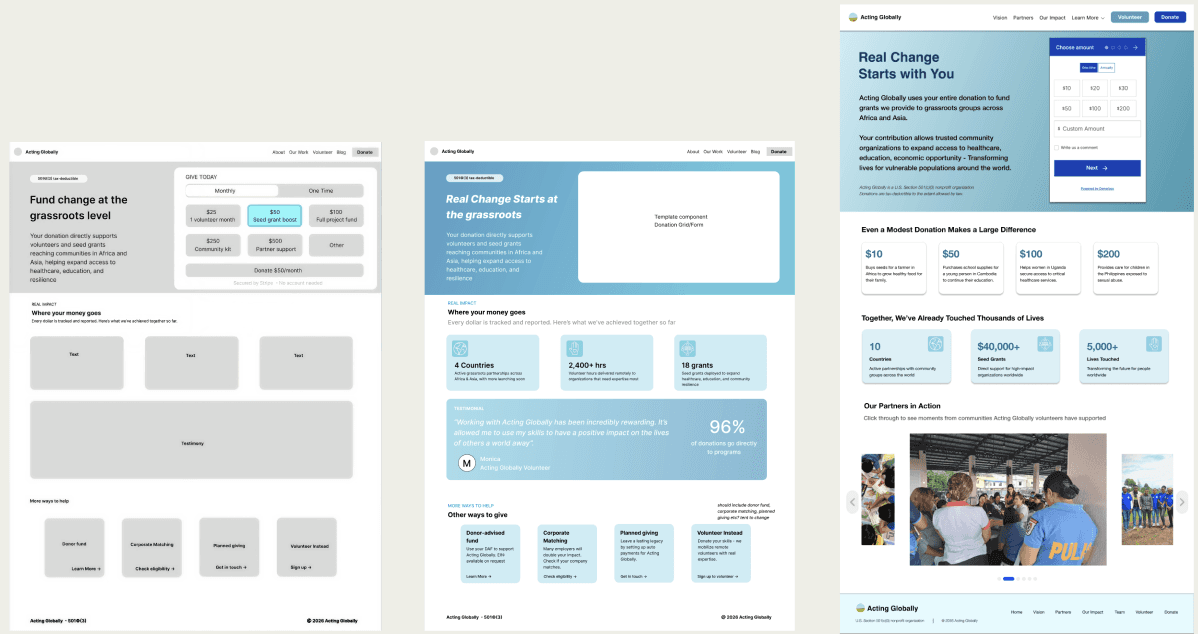
Moving into digital wireframes, we heavily simplified the site's primary navigation categories. We consolidated secondary information to reduce cognitive load and surfaced the mission and impact metrics to the very top of the hierarchy to immediately build user trust.
Call-to-Action (CTA) Standardization:
We redesigned the volunteer and donation pathways with consistent button styles and strategic placement. For example, the donation wireframes underwent multiple iterations: progressing from basic input fields to standardized giving tiers ($10, $50, $100) paired directly with messaging that explained exactly where the money goes. These designs were validated with stakeholders prior to adding high-fidelity styling.
3. High-Fidelity & Technical Handoff
Expert Review & Polish:
Before finalizing the UI, we conducted a design critique with a University of Washington HCDE alumni network to gather expert feedback on the Figma prototype. This led to further refinements in reducing text density and balancing the pages with more engaging imagery and volunteer testimonials.
Development Translation:
The finalized high-fidelity designs were then translated into a functional, coded MVP using HTML, CSS, JavaScript, and React. We successfully deployed this first iteration to Acting Globally's hosting domain, ready for backend integration.





Solution/Final Results
The final solution delivered a cohesive, mission-driven web experience that successfully bridged the gap between passive visitors and active contributors. By deploying a functional, first-iteration MVP built with HTML, CSS, React, and JavaScript, we provided Acting Globally with an accessible, intuitive platform that strengthened their organizational credibility and eliminated navigation friction. The success of the project extended beyond the classroom: our capstone sponsor adopted our final iteration as the foundation for Acting Globally's new website and has continued collaborating with our team to officially launch it for public use. The redesign empowered users with clear pathways to volunteer and donate, fostering deeper engagement with the organization's global initiatives while establishing a scalable foundation for future backend integration and continued organizational growth.
Final Product
Conclusion
This project served as a masterclass in balancing user needs with organizational priorities and technical constraints, reinforcing that continuous stakeholder involvement is the backbone of any successful digital transformation. Serving in the dual role of Product Manager and UX Designer required me to constantly bridge the gap between high-level strategy and pixel-perfect execution, ensuring that every design decision directly supported the organization's operational goals. By validating assumptions early through regular feedback sessions, we were able to accurately identify pain points and refine our solutions rather than relying on initial ideas.
Navigating this intersection of design and product management, especially when adapting to shifting requirements during the technical handoff, was a formative experience that solidified my passion as an aspiring product manager. Ultimately, this cross-functional collaboration demonstrated firsthand how small, iterative design changes can significantly improve user trust, drive engagement, and support a global mission.